Foundational Science: The Autonomic Nervous System
"I came to understand mind-body integration because I needed it... I believe in this work because I have lived it."
- Dr. Shanti M. Pepper, Ph.D.
Foundational Science: The Autonomic Nervous System
Before we move from my personal, educational, and professional journey into the more practical clinical content, I want to return briefly to where this all began.
I came to understand mind-body integration because I needed it. Years ago, a running injury took away what had been my primary, albeit painfully inadequate, coping strategy. In searching for ways to heal, I was introduced to practices that addressed not only physical recovery, but also the relationship between the body, mind, and nervous system. I didn't seek them out because I intended to teach them one day. I sought them out because I needed them. I believe in this work because I have lived it.
What I discovered through that process, with the guidance of exceptional mentors, is supported by a growing body of peer-reviewed research. Practices such as mindfulness, breathwork, movement, imagery, and somatic awareness can influence the physiological states of our autonomic nervous system, which in turn affect mental and emotional health (Hopper et al., 2019; Pearce et al., 2022).
Despite the growing evidence, many clinicians remain hesitant to incorporate whole-health approaches into their work. Sometimes the science feels difficult to explain. Sometimes concerns about ethics, scope of practice, or professional credibility create understandable hesitation. Sometimes the language simply doesn't feel natural.
The Whole Therapist™ was created to help bridge that gap between evidence and application. My goal is to provide a clear research foundation for whole-health interventions while demonstrating how to introduce them ethically, confidently, and within our scope of practice. Throughout the course, I share the frameworks, adaptable scripts, practical tools, and demonstrations that have helped me integrate these approaches into therapy while maintaining both scientific rigor and clinical flexibility.
To understand why these practices can be so effective, we first need a basic understanding of the nervous system. From there, we'll explore one of the most useful psychoeducational frameworks I use in therapy, Dr. Dan Siegel’s Window of Tolerance, to discuss a few important clinical precautions, and return to the growing body of research that helps explain why these approaches can have such a meaningful impact on health and healing.
Are you ready to put our science and anatomy hats back on?
Nervous System and Regulation
So, let's do a quick refresher on how the nervous system functions. The nervous system is divided into the command center, the brain and spinal cord, also known as the central nervous system (CNS), and the information transmission center, the cranial and spinal nerves, also known as the peripheral nervous system (PNS).
For our purposes, the most important part of the peripheral nervous system is the autonomic nervous system (ANS), which regulates involuntary processes such as heart rate, blood pressure, digestion, and breathing. The ANS contains several interconnected systems, but in therapy, we are primarily concerned with two: the sympathetic nervous system (SNS) and the parasympathetic nervous system (PSNS).
The sympathetic nervous system (SNS) is commonly referred to as our fight-or-flight system and is associated with many of the survival responses we observe clinically, including patterns of fighting, fleeing, freezing, or appeasing under threat. The SNS triggers action or inaction when under duress. This is our gas, foot-to-the-floor, get-out-of-dodge state. Or, depending on the situation, fight like hell, climb a tree, play dead, or feed the bear state of functioning. The SNS tends to activate rapidly in response to perceived threat and is often slow to settle once activated.
The parasympathetic nervous system (PSNS) is the foot-off-the-gas, easy-on-the-brake, slow-it-down state. It is responsible for maintaining homeostasis and returning us to our rest-and-digest modes of operation when it is safe to conserve energy. While the SNS is designed for rapid mobilization, parasympathetic recovery is often slower and can become more difficult to access when stress becomes chronic.
Ideally, these two systems work in tandem within a regulated nervous system, distributing the right amount of energy and oxygen to the organs and muscles that need it most in response to internal and external stimuli. Sympathetic pathways are activated by situations that trigger fear or survival states, while parasympathetic pathways become more active when the "all clear" is delivered and the body can rebuild, recover, and redirect resources toward long-term sustainability. The SNS is like a single-throw light switch in terms of activation, whereas activating the PSNS is akin to slowly turning up the dial on a dimmer switch.
That's a lot of technical "nesting-doll" jargon to explain to clients, so I typically skip the full nervous system description and jump right into describing the on/off activity of the SNS and PSNS, where our therapeutic focus lies.
A Nervous System Regulation Framework Clients Can Relate To
The psychoeducational framework I consistently find successful with clients is Dr. Dan Siegler's Window of Tolerance (WOT), which is grounded in somatics and trauma-informed practices. I've been using this framework for a very long time. It comes naturally to me after all this time, so it has remained my primary framework. If you are interested in a different approach, Dr. Stephen Porges's Polyvagal Theory provides a complex ANS regulatory framework.
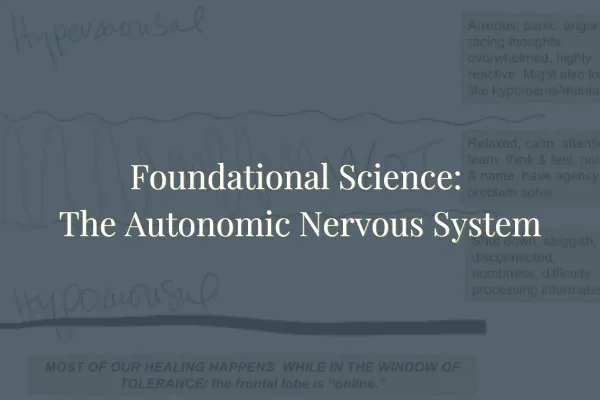
The first thing I do to introduce the Window of Tolerance framework is grab my notebook and draw something that looks like this…

Simple, right? We want to spend the majority of our time within our Window of Tolerance (WOT), where our nervous system is regulated and functioning at optimal levels, and our body can recover, restore, and heal best for the next really big threat.
Within our WOT, cognitive functioning is focused and organized, our emotions are controlled and stable, and our bodies are appropriately calm and/or active. We can monitor whether we move outside our WOT by noting emotional states that we easily identify as problematic for our functioning: higher levels of anxiety, panic, anger, etc., which likely indicate hyperarousal; high levels of sluggishness, disconnection, disinterest, numbness, etc., which likely indicate hypoarousal.
Here's what's not so simple. Many of our clients, frequently those who are or have been the highest-functioning in their fields of expertise, are required to perform with their sympathetic nervous systems activated, so they are continuously pushing themselves outside their natural window of tolerance. Other clients have inadequate coping mechanisms to deal with enduring stressors or traumas that have pushed them out of their window of tolerance for extended periods.
This disrupts the natural rhythms of the entire ANS, making it difficult for the healthy interplay between the sympathetic and parasympathetic systems to maintain cooperative regulation. And the thing is, some of them have continued to function for so long in unregulated states that they don't even realize they are compromised. Until, that is, they throw their back out putting on their underwear, like I did.
These dysregulated clients may include our first responders, those running into the burning building or towards the guy with the gun when all others are running away. Or the clients who are afraid of public speaking, whose careers require them to present in front of conference rooms filled with high-powered people, while their nervous system is screaming, "run!" Or our clients who have faced long-lasting or uncontrollable trauma situations, be it abuse, combat, prolonged illness, injury, job loss, or the sudden, tragic death of a loved one.
There are so many ways clients can end up in acute or prolonged dysregulated states of hyper- or hypoarousal, operating outside their windows of tolerance, without the tools to bring themselves back into regulated states. Some clients have such a narrow window of tolerance that they find themselves fluctuating from exhausting hyper-alert modes of operation to crashes of near-complete inoperability.
Research shows that we can help our clients recognize, identify, and return to a more balanced, functioning, and sustainable state through many psychotherapies, but what also works is whole-health interventions such as mindfulness practices and breathwork. We can even help our clients expand a narrow WOT, giving them a broader functional area in which to operate comfortably. But before giving you a few examples of research that substantiates our ability to manipulate our ANS, thereby improving our functioning by keeping us regulated within our WOT, I need to address an important caveat.
Holistic Therapies are not for Everyone
Whole health therapies are not universally appropriate for everyone. As you know, if a client is experiencing mania, active psychosis, or shows up to therapy intoxicated, they probably need medical interventions. Sometimes, a client's physical limitations may necessitate collaboration with a primary caregiver and the completion of thorough documentation/release of information forms to ensure safe exposure for both you and the client.
Some clients may manifest complex trauma in their bodies or experience dissociation that can be triggered by whole-health practices. Others may need to process issues related to cultural, religious, and even family values and traditions before they are comfortable with holistic integrations. They may want to consult other influential people in their lives about the compatibility of whole-health interventions with their belief systems before participating. Clients with significant body image issues may find focusing on their body uncomfortable or even disturbing. And some clients simply have no interest.
Traditional seated or silent whole-health practices may mimic freeze states and intensify dissociation, or a client might have such hyperarousal that being still feels physically uncomfortable. So when clients experience physical discomfort, or the stillness feels like shutdown, freeze, or helplessness rather than calm, then we need to be very conscious of client safety. If we decide to discuss these practices at all, we need to introduce these practices in a trauma-sensitive, culturally respectful way that supports client agency, and attend deeply to our clients' experiences throughout all therapeutic integrations, staying mindful of contraindications by going slow and checking in more often than we might otherwise.
Oh, the Beautiful Research!
Research surrounding whole-health interventions for both physical and mental health has expanded dramatically over the past decade. For me, this research is particularly exciting because it bridges the gap between what many of us observe clinically and what we can now demonstrate empirically. As I tell my clients, "whole-health practices aren't just for hippies anymore." We are scientists as well as artists, and whole-health interventions have a growing body of evidence supporting their efficacy. To get you started, here are two of my favorite studies:
Hopper et al. (2019) published a review of three studies examining the relationship between diaphragmatic breathing practices and stress markers. Across these studies, diaphragmatic breathing was associated with improvements in salivary cortisol levels, respiratory rates, blood pressure, and scores on the stress subscale of the Depression Anxiety Stress Scale-21 (DASS-21). In other words, we can intentionally influence physiological stress markers through our breathing, which in turn can help alleviate emotional distress.
Pearce et al. (2022) published a massive meta-analysis examining the relationship between physical activity and depression. Across the included studies, accumulating approximately 2.5 hours of movement per week, particularly walking, was associated with a 25% lower risk of depression. Even half that amount was associated with an 18% reduction in risk. Slow and steady movement matters.
These studies represent only a small glimpse into a rapidly growing body of research supporting whole-health approaches. The exciting part is that many of these interventions are simple, accessible, and adaptable, making them powerful tools for both clinicians and clients.
My hope is that this course helps you feel more confident discussing, teaching, and integrating these practices in ways that are evidence-based, ethical, and authentic to your clinical style.
I look forward to learning alongside you.
See you on the inside.

To find out more about my courses, take a quick peek. Also, feel free to reach out to me personally with any questions at [email protected].
The Beyond the Basics workshop is aimed at helping therapists truly evolve as trauma specialists, explore holistic approaches to healing, feel centered and confident as a provider, transform their clients' lives, and stay in love with their career. Beyond the Basics: Developing Expertise in the Treatment of Trauma (up to 15 CE units)
The Whole Therapist is an online course that teaches holistic interventions driven by 'lifestyle is medicine' principles. This course will help you personally mitigate clinician burnout and introduce adaptable tools to help your clients between sessions.
The Whole Therapist: A Holistic Integration Course for Therapists Ready to Deepen Their Care-and Their Impact (up to 10 CE units)
Summer Sale: Get $100 off using code SummerLifestyle2026 at checkout
References:
Pearce, M., Garcia, L., Abbas, A., Strain, T., Schuch, F. B., Golubic, R., Kelly, P., Khan, S., Utukuri, M., Laird, Y., Mok, A., Smith, A., Tainio, M., Brage, S., & Woodcock, J. (2022). Association between physical activity and risk of depression: A systematic review and meta-analysis. JAMA Psychiatry, 79(6), 550–559. https://doi.org/10.1001/jamapsychiatry.2022.0609
Hopper, S. I., Murray, S. L., Ferrara, L. R., & Singleton, J. K. (2019). Effectiveness of diaphragmatic breathing for reducing physiological and psychological stress in adults: A quantitative systematic review. JBI Database of Systematic Reviews and Implementation Reports, 17(9), 1837–1876. https://doi.org/10.11124/JBISRIR-2017-003848
